
What Does a DEXA Scan Show? A Complete Breakdown of Your Results
Updated: Apr 9
If you have heard that a DEXA scan is the gold standard for body composition testing but are not sure what it actually measures, this is the breakdown. A DEXA (Dual-Energy X-ray Absorptiometry) scan gives you far more than a single body fat number.
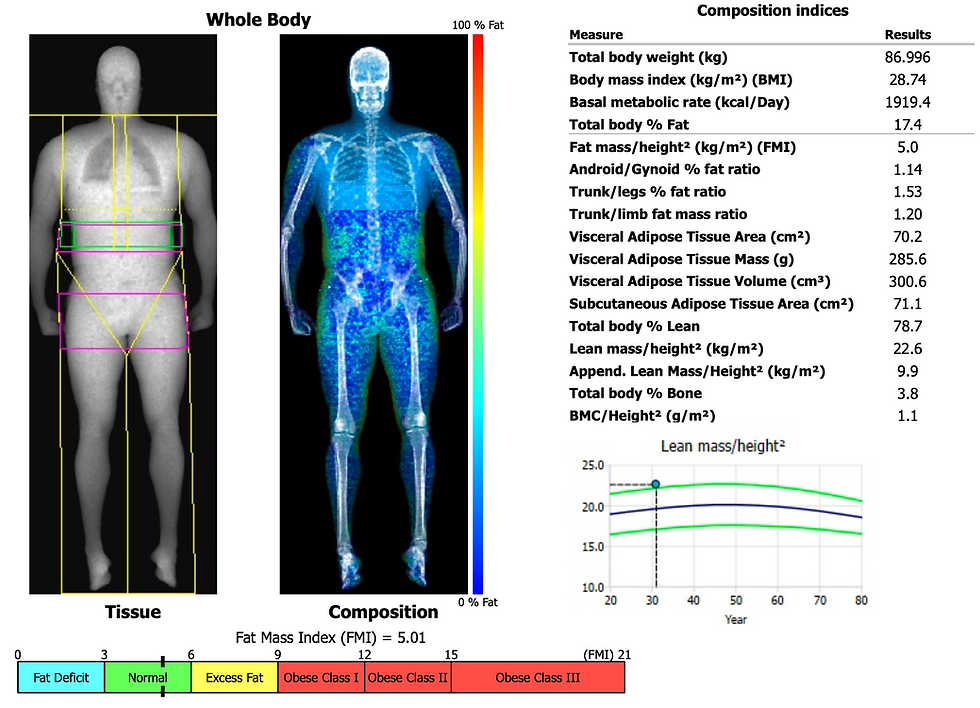
It provides a detailed, region-by-region map of what your body is made of fat, lean tissue, and bone, along with specific health markers you cannot get from any other method outside of a hospital.
Total Body Fat Percentage
This is the number most people come in for. Your DEXA report shows your total body fat as a percentage of your total body mass, measured with an accuracy margin of approximately 1 to 2 percent. That level of precision matters. It is accurate enough for clinical decision-making and for detecting real changes in your body over time, rather than noise caused by hydration or time of day.
Your report will also show your total fat mass in kilograms and total lean mass in kilograms, giving you the raw numbers behind the percentage.
Regional Body Composition Breakdown
This is where DEXA separates itself from every other body composition method. Your report breaks down fat mass, lean mass, and bone mineral content for each region of your body:
Want to know your exact numbers? Book a DEXA body composition scan at Precision Body Lab → https://www.precisionbodylab.com.au/book-online
Left arm and right arm
Trunk (torso)
Left leg and right leg
This regional data lets you see exactly where fat is stored and where lean mass is distributed. It also reveals bilateral asymmetries. For example, if your right leg carries significantly more lean mass than your left. Differences of more than 5 percent between limbs may indicate compensation patterns, injury history, or training imbalances worth investigating.
Android and Gynoid Fat Distribution
Your DEXA report includes two specific fat distribution zones that are clinically significant:
Android region (midsection/waist). This measures fat stored around your abdomen. Higher android fat is associated with increased cardiometabolic risk. This is the classic "apple" body shape distribution.
Gynoid region (hips/upper legs). This measures fat in the hip and thigh area. Gynoid fat is primarily subcutaneous (under the skin) and is generally considered less metabolically dangerous than android fat. This is the "pear" shape distribution.
Android-to-Gynoid (A/G) Ratio
Your report calculates the ratio between your android and gynoid fat percentages. This A/G ratio is a clinically validated marker of cardiovascular risk that total body fat percentage alone cannot capture. A lower A/G ratio indicates more fat is stored in the lower body relative to the midsection, which is generally associated with lower metabolic risk. Tracking this ratio over time is more informative than tracking body fat percentage alone, because it shows where your body is gaining or losing fat - not just how much.
Visceral Adipose Tissue (VAT)
Visceral fat is the fat stored deep inside your abdomen, surrounding your organs. It is metabolically active and behaves differently from the subcutaneous fat you can pinch. Elevated visceral fat is strongly linked to increased risk of type 2 diabetes, cardiovascular disease, and metabolic syndrome. Even in people whose total body fat percentage looks normal.
Your DEXA report shows your VAT measurement in cm2, grams, and cm3. General risk thresholds are:
Below 99cm2: Low cardiovascular risk.
99cm2 to 159cm2: Moderate risk that warrants attention.
Above 160cm2: Elevated risk that may require intervention.
DEXA is one of the only practical methods outside of a CT or MRI scan for quantifying visceral fat. DEXA visceral fat measurements correlate strongly with CT scan results (r = 0.93), making it a reliable and accessible way to monitor this critical health marker.
Lean Mass by Region
Your DEXA report shows lean tissue mass for each body segment (arms, legs, and trunk) individually. This is valuable for several reasons:
Identifying muscle imbalances between your left and right sides.
Verifying that weight loss is coming from fat, not muscle. This is critical during caloric deficits. Aggressive diets can strip lean tissue along with fat, and DEXA is the most reliable way to check.
Tracking muscle gain in specific areas, useful for athletes and anyone following a structured training program.
Monitoring lean mass preservation in older adults, where sarcopenia (age-related muscle loss) is a major health concern.
Bone Mineral Density (BMD)
A whole-body DEXA scan provides a total bone mineral density reading and total bone mineral content. This gives you a snapshot of your overall bone health. While a whole-body DEXA composition scan is not used to formally diagnose osteoporosis (that requires a specific hip and spine DEXA scan), the bone data from a composition scan can identify whether your bone density warrants further investigation.
This matters for anyone at risk for low bone density, including post-menopausal women, people with low body weight, those with a family history of osteoporosis, and anyone taking medications that affect bone health.
Trend Tracking Across Multiple Scans
One of the most valuable aspects of a DEXA scan is what it shows over time. When you have two or more scans, your report includes trend data showing exactly how your body has changed; how much fat you have lost, how much muscle you have gained, whether your bone density is stable, and how your regional distribution has shifted.
Because DEXA has a test-retest precision of less than 1 percent, even small changes in your body composition are detectable and meaningful. This is why DEXA is the preferred method for anyone who takes their health, training, or body recomposition goals seriously.
What DEXA Does Not Show
A DEXA scan provides body composition and bone density data. It does not diagnose medical conditions, and it does not measure hormones, blood markers, or metabolic rate. It also does not differentiate between types of lean tissue (for example, it cannot distinguish muscle from organ tissue within a region). For a complete health picture, DEXA results are best used alongside blood work and other assessments as recommended by your health professional.
At Precision Body Lab in Miranda, your DEXA scan includes a detailed results consultation where we walk you through every section of your report. Initial scans start at $149 and include a full body composition scan plus a one-on-one consultation to help you understand your numbers and set data-driven goals.
Ready to see your own results?
Book a DEXA body composition scan at Precision Body Lab - Sydney’s dedicated DEXA clinic in Miranda. Trusted by 1,000+ clients, rated 5 stars on Google.
Book your scan → https://www.precisionbodylab.com.au/book-online


Comments